
In the AI race, a new contender is rising. On August 13, Elon Musk's xAI launched Grok-2 and Grok-2 mini, reshaping the market landscape with these new AI model iterations.
Table of ContentsShowHide
Grok-2's Market Positioning and Technological Breakthroughs
xAI's strategy is clear: a one-two punch with Grok-2 and Grok-2 mini to cater to different market segments. Grok-2 mini, a streamlined version of Grok-2, targets applications requiring rapid response. Both models are currently being tested on the X platform, with xAI planning to roll out API versions this month, which will undoubtedly accelerate penetration in the developer community.
Notably, Grok-2 has outperformed heavyweight players like Claude 3.5 Sonnet and GPT-4-Turbo in text generation. Compared to its predecessor Grok-1.5, the new model significantly improves critical areas such as chat, code generation, and logical reasoning.
Performance
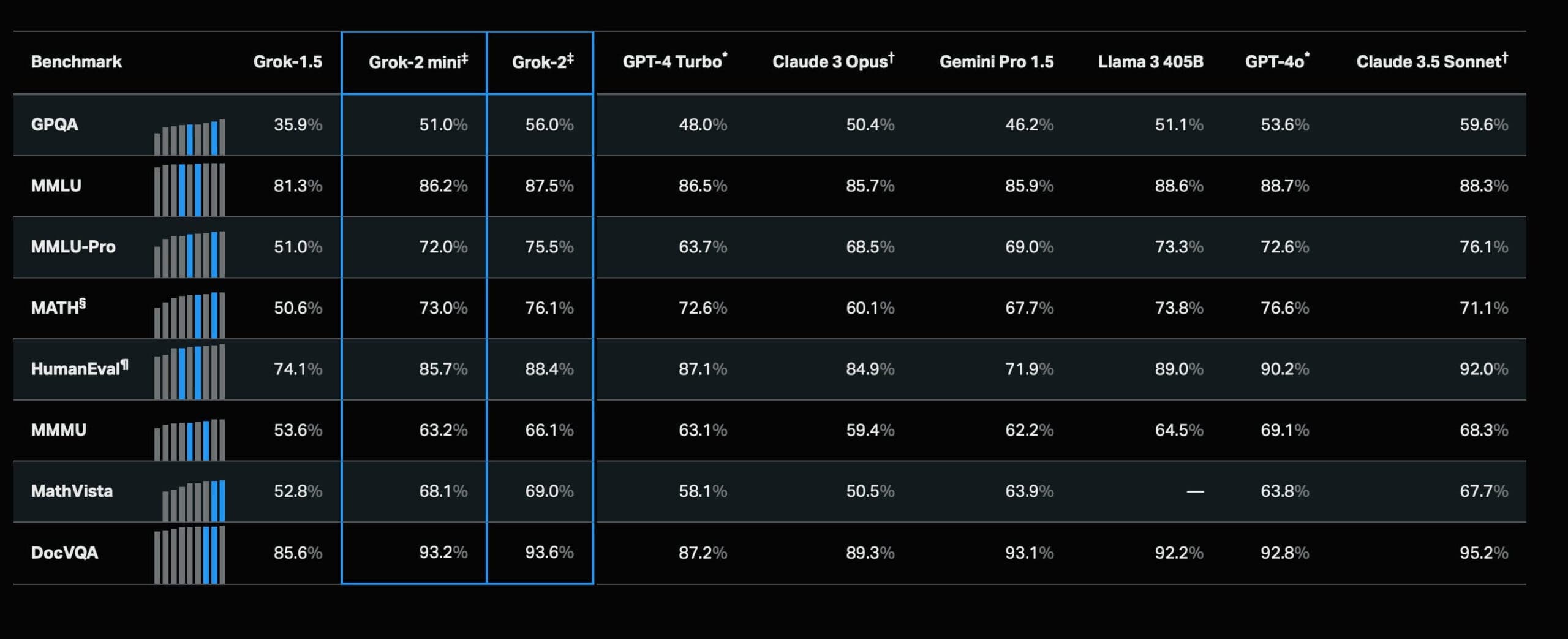
Grok-2's performance in standard benchmarks is impressive. It scores on par with GPT-4o and Llama 3.1 405B in tests like MMLU, MATH, and HumanEval, surpassing Gemini 1.5 Pro. In Chatbot Arena user ratings, Grok-2 ranks fourth, just behind the latest GPT-4o and Gemini 1.5 Pro, but ahead of well-known models like Claude 3.5 Sonnet. These metrics indicate that Grok-2 has joined the ranks of top-tier AI models.
Image Generation
Grok-2's performance in image generation is particularly noteworthy. Many reviewers suggest that the quality of its generated images matches or exceeds that of Midjourney. However, what's more striking is Grok's relatively relaxed content moderation policy. While controversial, this "minimal censorship" positioning carves out a unique market niche. This strategy challenges conventional notions of how AI tools should be used and managed.
Challenging the Established Players
With the rapid rise of Meta and xAI, the competitive landscape in AI is shifting. The original triumvirate - OpenAI, Google, and Anthropic - has now expanded into a five-way battle. This shift highlights a critical factor in AI development: with sufficient computational resources, any company has the potential to make breakthroughs in this field.
For traditional leaders like OpenAI, this serves as a wake-up call. Intensified market competition means the pace of innovation must accelerate or risk being overtaken by emerging forces. However, OpenAI seems to have been preoccupied with internal affairs recently, potentially impacting its progress in technological innovation.
In this rapidly evolving AI market, maintaining technological leadership and market agility will determine success or failure. The rise of xAI not only reshapes the market landscape but also injects new vitality and competitive drive into the entire industry. More breakthrough innovations and unexpected market changes will likely emerge in the future.